
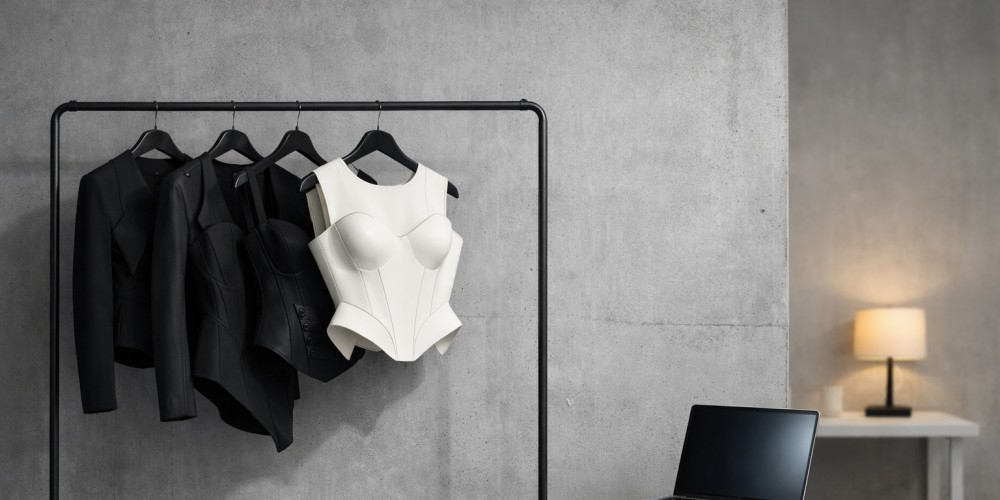

Paris Fashion Week has hosted plenty of unexpected collaborations over the years, but the scene this past July was something genuinely new: a co-branded capsule collection launch on a boat on the Seine, with OnlyFans as the presenting partner. The brand in question was Pleasures. The other co-branded collection came from LGN — Louis-Gabriel Nouchi, the French designer whose FW26 show in a Le Marais parking garage mixed techno, body-conscious silhouettes, and what one observer described as “cosmic eroticism.” In the weeks before Fashion Week, London label Poster Girl had already unveiled a latex capsule through the same partnership model. Three brands, one platform, one fashion week cycle — and a signal that OnlyFans is executing a deliberate, multi-year strategy to reposition itself as something much broader than its original reputation suggested.
For adult creators who built their businesses on OnlyFans, that repositioning is worth paying close attention to — not because it threatens what they do, but because it changes the context around the platform they work on.
The fashion push didn’t come out of nowhere. OnlyFans launched a music-focused Creative Fund in 2021 and a fashion-focused one in 2022, with designer Rebecca Minkoff — who became the first prominent fashion figure to open an OnlyFans profile in February 2021 — involved in the early rollout. The Creative Fund eventually evolved into a reality competition format; its most recent fashion edition featured stylist and image architect Law Roach as a star judge. Designer Elena Velez brought a streetwear capsule to the platform during New York Fashion Week in April 2025. Rick Owens launched a profile later that year, donating proceeds to a foundation supporting young transgender people. Collina Strada founder Hillary Taymour used her channel for a fashion and merch business masterclass. The LGN collaboration, which includes exclusive films, ASMR content, behind-the-scenes access, and appearances on OFTV — the platform’s free streaming channel — represents the most integrated version of this strategy yet, according to reporting from NSS Magazine.
The reason fashion brands are showing up now has less to do with OnlyFans specifically and more to do with what Instagram has stopped delivering. As NSS Magazine reported, engagement for luxury brands on Instagram has dropped sharply in recent years even as posting frequency has stayed the same. Algorithms increasingly reward paid placement over organic reach. Brand profiles have grown corporate and distant. And designers who post anything touching on the body or sensuality — themes that have always been central to fashion’s visual language — run into content moderation friction that OnlyFans simply doesn’t impose on its creators.
OnlyFans, by contrast, is subscription-based and not advertising-funded. It doesn’t need to optimize content for an infinite scroll. Subscribers actively choose to pay for access, which filters out the bots, trolls, and ambient hostility that make Instagram increasingly unpleasant for brands and creators alike. As NSS Magazine put it, the platform “opens a direct relationship between creators and those who consciously choose to subscribe.” That dynamic — smaller, intentional audiences over massive, disengaged ones — is the same logic driving creator migration toward Substack, long-form YouTube, and Discord communities.
Vanity Teen described the LGN collaboration as something more than a marketing exercise: “Rather than treating OnlyFans as another marketing tool, he’s using it as a creative medium.” The campaign, shot in London by photographer Tré Koch, was framed around intimacy and sensuality rather than provocation — “less about provocation than seduction,” in the publication’s words. The collection itself sits between underwear, sportswear, and fashion, which is precisely the kind of body-forward aesthetic that gets flagged on other platforms and thrives on this one.
Creator Revenue Impact
The direct revenue impact of OnlyFans’ fashion repositioning on adult creators is, at this point, mostly indirect — and the available evidence doesn’t support any conclusion that subscription payouts, payment processing, or account stability are being affected right now. What the fashion push does signal is a platform investing heavily in mainstream brand credibility, and that has longer-term implications worth tracking.
The most concrete near-term effect is competitive: as OnlyFans attracts fashion designers, mainstream celebrities, athletes, and lifestyle creators, the platform’s subscriber base and traffic will likely grow and diversify. A larger, more varied audience is generally good for discoverability, especially for creators whose work sits at the intersection of fashion, aesthetics, and adult content — a space that’s always existed on the platform but now has more cultural legitimacy around it.
The longer-term question is about platform priorities. When a platform begins courting mainstream brand partners and building a reality-TV pipeline with high-profile judges, it is also building relationships with advertisers, press, and institutional partners who may eventually push for content moderation standards that look more like Instagram’s than OnlyFans’ current model. That hasn’t happened — OnlyFans has not announced any policy changes, and the fashion collaborations are explicitly being positioned around the platform’s freedom from restrictive moderation. But creators who have lived through the 2021 near-ban on adult content (which OnlyFans reversed within days after creator and industry backlash) know that platform policy can shift quickly and that diversification across multiple revenue channels remains the most durable protection against that risk.
For studios and agencies managing multiple creator accounts, the fashion repositioning also matters for how OnlyFans is perceived by payment processors and banking partners — institutions that have historically been the most significant external pressure point on adult-content platforms. A platform with stronger mainstream brand associations and a more diversified creator base is, in theory, a lower-risk client for those partners. Whether that translates into more stable payment processing for adult creators specifically is unknown, but it’s a reasonable structural benefit to watch for.
Branding and Audience Lessons
The most transferable lesson from the LGN collaboration isn’t “collaborate with a fashion brand.” It’s that the creators and brands getting the most out of OnlyFans right now are treating it as a creative medium rather than a distribution channel. Nouchi is using his channel for ASMR experiments, exclusive films, and behind-the-scenes storytelling — content that builds a world around his work rather than just promoting it. That approach maps directly onto what successful adult creators have been doing for years: building subscriber relationships around personality, access, and ongoing narrative rather than transactional content drops.
For established creators with an existing subscriber base, the fashion moment offers a real opening. Sensuality, body confidence, and aesthetic identity are now being discussed in mainstream fashion press as OnlyFans’ competitive advantages. Creators who already operate in that space — who have developed a visual identity, a consistent aesthetic, or a point of view about desire and self-presentation — are well-positioned to attract crossover subscribers who arrive through fashion or lifestyle discovery rather than adult-content search. That’s a meaningful audience diversification opportunity, particularly as algorithmic discovery on other platforms becomes less reliable.
For smaller or newer creators, the lesson is more modest but still useful: the platform’s evolving mainstream profile makes it easier to explain an OnlyFans presence to potential collaborators, press contacts, or brand partners without the conversation immediately defaulting to stigma. That’s a real, if incremental, shift in the professional environment. It doesn’t mean every creator should chase fashion partnerships or rebrand around aesthetics — most won’t have the audience or infrastructure to make that work. But it does mean the cultural ceiling on what OnlyFans-based creators can credibly pitch to outside partners is rising.
What remains to watch: whether OnlyFans’ mainstream fashion credibility translates into any formal changes to platform policy, creator support resources, or content moderation standards — and whether the growing presence of non-adult creators affects how the platform allocates its promotional tools and recommendation systems. The platform has not announced changes on any of those fronts. But the trajectory is clear enough that creators and operators who depend on OnlyFans as a primary revenue platform have good reason to follow where this goes.