

Age verification just became a line item — not just a legal headline — and a new integration between website-building platform MyMember.site and the Free Speech Coalition’s PrivateAV tool shows exactly how that shift is landing for independent adult creators who run their own sites.
MyMember.site announced on June 5, 2026, that it has built FSC’s PrivateAV age-verification solution directly into its platform. The practical upshot: creators using MyMember.site to host their content automatically get age-verification functionality switched on in regulated states, with no custom coding or outside developer required. Visitors from those regions see a safe-for-work landing page first, complete the verification process, and then access the site.
The timing is not accidental. One day earlier, FSC published a reminder that West Virginia’s age-verification law, HB 4412, takes effect June 12, 2026 — and the stakes attached to that deadline are serious. Under the law, any site where at least one-third of content qualifies as sexual material harmful to minors is required to verify visitor ages using digital ID, government-issued ID, or a commercially reasonable verification system. Non-compliance exposes sites to a private right of action worth $10,000 per violation plus damages, and the state Attorney General can pursue civil penalties of up to $10,000 per day, plus up to $250,000 if a minor actually accesses the site.
West Virginia is one state in a growing list. The compliance pressure is real, it is accelerating, and for creators who operate independently — outside the umbrella of a large platform that handles this infrastructure on their behalf — the question of how to comply is no longer theoretical.
“Age-verification laws can be expensive and burdensome, especially for smaller, independent platforms,” FSC Executive Director Alison Boden said in the announcement. “Because we’re a non-profit, we’re able to offer PrivateAV at close to cost, using protocols that better match the needs of our members. Best of all, PrivateAV isn’t financing the for-profit age-verification industry behind many of these laws.”
That last point matters. Several state-level AV laws have been criticized by FSC and others as having been shaped, at least in part, by for-profit verification vendors with a financial interest in mandating their own services. PrivateAV is positioned explicitly as an alternative to that pipeline.
The Compliance Fork in the Road
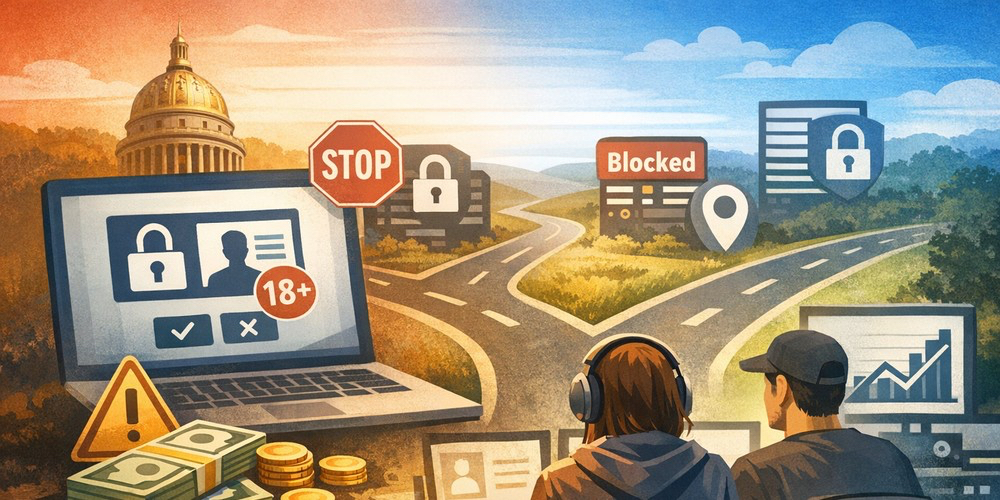
For adult creators, there are currently a few distinct paths to age-verification compliance, each with different costs, tradeoffs, and fan-conversion implications.
Platform-native AV is the lowest-friction option for most creators. Large subscription and clip platforms handle verification at the platform level, meaning creators who operate exclusively on those platforms are largely insulated from direct legal exposure — the platform absorbs the compliance obligation. The tradeoff is the familiar one: platform dependence, revenue splits, and limited control over the fan relationship.
Third-party widgets and integrations — like the MyMember.site/PrivateAV setup — sit in the middle. They give independent site operators a compliance solution without requiring custom development, and because they’re built into the hosting infrastructure, the friction of implementation is low. The cost question depends on the specific service, but FSC’s nonprofit positioning means PrivateAV is designed to undercut commercial alternatives on price.
Geoblocking is a blunter instrument: simply blocking traffic from states with active AV laws entirely. It avoids compliance costs and legal exposure in those jurisdictions, but it also means losing all visitors — and potential subscribers — from those states. For creators with a large U.S. audience, that’s a meaningful traffic cut. As more states pass AV laws, geoblocking becomes an increasingly expensive non-solution.
Compliance landing pages — the SFW gate that PrivateAV uses — introduce a conversion step between a new visitor and your content. Any additional step in that funnel will reduce some percentage of visitors who don’t complete it. How much depends on the friction of the verification method, how clearly the page is designed, and how motivated the visitor is. This is a real tradeoff, not a hypothetical one, and creators running their own sites should think about it as a fan-acquisition cost of operating in a regulated environment — not a reason to skip compliance.
Creator Revenue Impact
The direct revenue impact of AV compliance depends almost entirely on where a creator’s traffic comes from and how their business is structured. Creators operating exclusively on major platforms that handle verification centrally are unlikely to see any immediate change. Creators running independent sites — or studios and agencies managing multiple creator properties — are the ones facing real decisions right now.
The costs are layered: there’s the direct cost of a verification service (reduced but not eliminated by nonprofit options like PrivateAV), the potential traffic loss from geoblocking regulated states, and the conversion friction introduced by a verification gate. None of these are catastrophic individually, but they add up as more states pass laws and the compliance map expands.
The $10,000-per-violation private right of action in West Virginia is the sharper edge. It creates a litigation risk for non-compliant independent sites that is separate from any government enforcement — meaning a private plaintiff, not just a state AG, could potentially bring a claim. Creators and operators with independent sites in scope should treat legal review as a cost of doing business, not an optional upgrade.
What the evidence does not yet support is a clear picture of how much PrivateAV-style gates affect subscription conversion rates in practice. That data, if it exists, hasn’t been published publicly.
Creator Safety and Reputation Risk
The safety and privacy dimension of age verification is worth understanding clearly, because not all AV systems are equivalent. Some commercial verification services collect and store government ID data in ways that create privacy exposure for both visitors and, indirectly, the platforms that require them. FSC’s framing of PrivateAV as a “privacy-conscious” alternative is directly responsive to that concern.
For creators, the reputation risk runs in two directions. Operating a non-compliant site in a state with an active AV law creates legal exposure that can surface publicly — enforcement actions and civil suits are public records. At the same time, choosing a verification vendor that handles user data poorly could create friction with privacy-conscious fans or, in a worst case, contribute to a data exposure event that reflects on the creator’s brand.
The risk here is not broad or immediate for most creators, but it is specific and concrete for anyone running an independent site accessible to U.S. visitors. The practical question is not whether to comply, but which compliance path creates the least privacy risk for fans and the least operational risk for the creator.
What Smaller Creators Can Actually Use
If you’re a smaller or newer creator, the MyMember.site/PrivateAV story is less about this specific integration and more about a strategic question you should be asking now: where does your compliance obligation actually live?
If your entire operation runs through a major subscription platform, that platform is almost certainly handling AV compliance on your behalf. You should verify that’s true — read the platform’s terms and any compliance communications — but you’re probably not the party with direct legal exposure.
If you have an independent site, even a simple one, and it’s accessible to U.S. visitors, you need to know which states have active AV laws and whether your site falls under their scope. FSC publishes an Age Verification FAQ that’s a reasonable starting point. This is not a reason to panic, but it is a reason to spend an hour understanding your actual situation.
The geoblocking-versus-verification-gate decision is real, and for smaller creators, geoblocking a single state may feel like the simpler path. But as the number of regulated states grows, that math changes. Building a compliance infrastructure now — even a lightweight one — is likely less disruptive than patching it state by state under deadline pressure.
What smaller creators should not copy from larger studios or platforms is the assumption that compliance is someone else’s problem. The private right of action in laws like West Virginia’s means that exposure doesn’t require a state AG to act — and smaller sites are not invisible to that risk just because they’re smaller.
The broader picture here is that age verification is becoming a permanent feature of the independent adult creator landscape, not a temporary political moment. The platforms and tools that make compliance cheaper and less technically demanding — and that don’t route fan data through opaque commercial systems — are going to matter more as the map of regulated states keeps expanding. West Virginia goes live June 12. More states are behind it.