
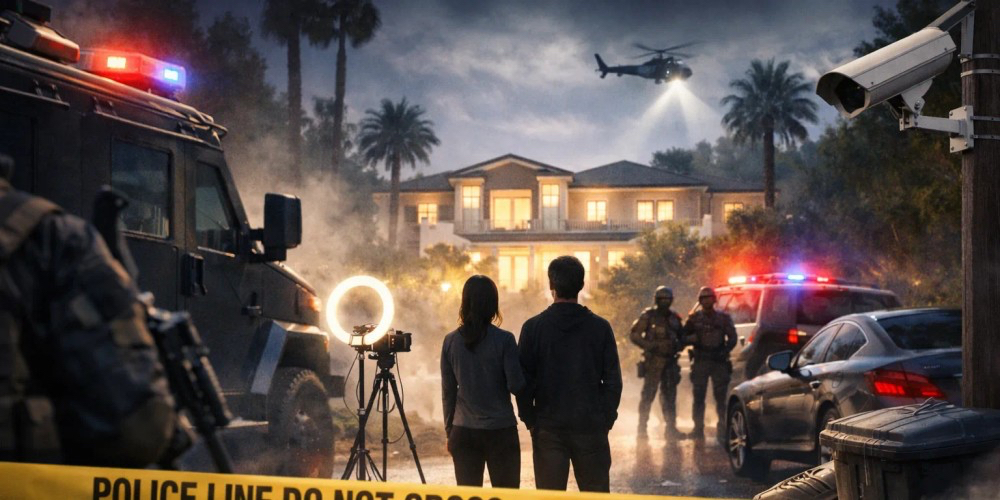

When your neighbors start calling your house an “OnlyFans Mansion” on the evening news, the conversation has moved well past a noise complaint. That’s the situation Andy Bachman, CEO of the talent management company Creators Inc., is navigating right now in Encino, California — and the fallout offers a useful case study for any creator or creator business that operates out of a residential property.
The dispute has been building for months, but it broke into national media coverage between June 15 and 17, 2026, when multiple local and national outlets published accounts from anonymous neighbors describing events at Bachman’s Encino mansion that they say draw 50 to 100 cars at a time, leave trash and other debris in the street, and once triggered a swatting incident that sent a SWAT team to the block. On June 17, Bachman responded publicly via Instagram and in a statement to TMZ, pushing back on what he called assumptions driven by the word “OnlyFans” rather than by evidence.
Here is what is confirmed: Bachman owns the Encino home, which he purchased in 2024 and describes as his personal residence. He is the CEO of Creators Inc., a talent management agency that works with digital content creators. The Creators Inc. logo is visible in a window of the property, and company-branded vehicles have been spotted out front, according to neighbors quoted by NBC 4 Los Angeles. Bachman acknowledges that many of the creators his company works with have OnlyFans accounts. He flatly denies that adult content is filmed at the property, telling KCBS, “We actually are not in the content production game at all. We’re in the talent management space and people who we work with film TikToks and Instagram reels.”
Bachman also told KCBS that the city has never issued a violation against the property. “We’ve never received a violation because the facts don’t match the story being told by a few anonymous neighbors,” he told TMZ. He added: “Too often, people hear ‘OnlyFans’ and substitute assumptions for evidence.”
Los Angeles City Councilmember Nithya Raman confirmed to FOX 11 Los Angeles that her office has been involved. “We convened a community meeting with the City Attorney’s Office and LAPD when noise complaints and other issues were brought to our attention, and many of the original concerns have since been mitigated,” Raman said in a statement. “We have remained in touch with neighbors and continue to work closely with our partners at LAPD and the City Attorney’s Office to monitor the property and address ongoing issues.” The LAPD did not specify how many times officers had been called to the home, and the City Attorney’s Office had not responded to press inquiries as of the time of reporting.
The celebrity dimension of the story adds another layer. According to reporting from the California Post, the Encino property has hosted a roster of recognizable names for content production, including R&B artist Ray J, reality television personality Blac Chyna, actress Shannon Elizabeth — who claimed in a Creators Inc. video that she has earned over $1 million on OnlyFans — Carmen Electra, Denise Richards, rapper Offset, and UFC fighters Paulo Costa and Merab Dvalishvili. Creators Inc. has built a following of hundreds of thousands across its social media accounts. The celebrity traffic underscores how the property functions as a content hub, regardless of how it is legally classified.
Neighbors who spoke to various outlets were not all focused on the content itself. Several told reporters their primary concern is the commercial nature of the operation in a residential zone. “It’s not just the morality,” one neighbor told KCBS. “It’s the fact that they’re running a business in a residential neighborhood. It’s not like they’re baking bread. There’s a constant stream of people coming in and out.” Another described events that leave the street lined with cars and debris. The swatting incident — a false emergency call designed to send armed police to a location — was confirmed by Bachman himself, who told CBS it was “obviously an annoyance and something I can’t have happening,” and said the company changed its policies afterward.
As of publication, no zoning violation has been issued, no charges have been filed, and the dispute remains active and unresolved.
Platform Policy Impact
This situation does not appear to involve any platform policy violations by OnlyFans or any other creator platform, and there is no indication that Creators Inc. or Bachman faces account-level consequences from any platform. The property dispute is a local zoning and neighbor-relations matter, not a content moderation issue.
What the story does illustrate, though, is a brand-association risk that creators and creator businesses should understand. The word “OnlyFans” in the property’s media nickname — the “OnlyFans Mansion” — has shaped public and press framing of the entire situation, even though Bachman explicitly states no adult content is produced there. That framing has amplified neighbor complaints, attracted national coverage, and drawn city government attention to what might otherwise have been a routine noise dispute.
For studios, agencies, and individual creators who manage residential production spaces, this is a concrete example of how platform-brand association can affect non-platform activity. If a property, business, or individual is publicly linked to OnlyFans — even through talent management rather than direct content production — that association can become the dominant narrative in a dispute, regardless of what is actually happening on-site. Platforms themselves are unlikely to change policies based on a single local zoning dispute, but payment processors and advertisers who monitor brand risk could, in a different context, react to sustained negative press coverage of a business they are associated with. That threshold has not been reached here, and there is no evidence any platform relationship is under review. Creators should treat this as a signal to watch rather than an immediate operational concern.
Creator Safety And Reputation Risk
The swatting incident confirmed in this case is the most serious safety issue in the story and deserves direct attention. Swatting — the practice of making a false emergency report to send armed law enforcement to a location — is dangerous for everyone present and has resulted in serious injuries and deaths in other cases. Bachman confirmed a swatting incident occurred at the Encino property and said Creators Inc. changed its policies in response. The specific nature of those policy changes was not detailed in available reporting.
For creators who operate out of residential locations, this case is a reminder that a publicly known address associated with a recognizable brand or platform name carries real physical risk. The more a property is featured in social media content, the more identifiable it becomes. Creators who film at home, host collaborators, or run agency operations from a residential address should consider whether their location is effectively public knowledge and what protocols they have in place if law enforcement is called to their address under false pretenses.
The broader reputation risk here is more diffuse but worth naming. Anonymous neighbor complaints, even unverified ones, can generate sustained media coverage when the “OnlyFans” label is attached. Several of the neighbor allegations reported across outlets — including claims about drug use and items found outside the property — are unverified and were made anonymously. Bachman has denied wrongdoing and the city has not issued violations. But the coverage exists, and it is indexed. For any creator or creator business operating a high-traffic residential space, the reputational exposure from neighbor disputes that reach local news is real and not easily corrected after the fact.
The risk here appears limited to creators and businesses operating physical production or management spaces, particularly in residential areas with high visibility. It is not a platform-wide or industry-wide safety concern based on current evidence. Creators who work entirely from private, low-profile locations and do not operate agency or studio functions from their homes face a much lower version of this risk.
What remains unresolved is whether Los Angeles will pursue any zoning or code enforcement action against the property, and whether the city’s ongoing monitoring — confirmed by Councilmember Raman’s office — will result in formal findings. Bachman has indicated he intends to keep operating and to keep advocating, as he put it, “for the rights of entrepreneurs to build businesses in the modern economy.” That argument — that content creation is legitimate work-from-home activity — is one the broader creator industry will likely need to make in more jurisdictions as the business scales. The Encino situation is an early, visible test of where those lines get drawn.